• Costflows Intelligence
  • Managing restaurants
    
    Solutions
    • Cost and Expense Control
    • Procurement Management
    • Inventory Management
    • Recipe and Menu Engineering
    • Multi Brands Management
    • Central Kitchen Management
    Report analysis
    • Purchase Analysis
    • Inventory Variance
    • Menu Profit Analysis
    • Supplier Performance Analysis
    • Actual and Theoretical Purchase Consumption Report
    Integration
    • Account l POS l ERP
    • Open API
  • Why us?
    
    Restaurant Type
    • Single Outlet
    • Chain Stores
    • Franchise Store
    • Central Kitchen
    • Vendors
    • Account Firm
    Restaurant Operation
    • Restaurant manager
      Ordering via Mobile APP
    • Kitchen|Chef
      Monitor Price Changes and Profit
    • Floor|Staff
      Stock Take and Menu Guide
    • Cloud Based | APP & WEB
      Access Anytime | Any Where
    • Decision Team | Management
      Instant Insight of Profit and Expense
    • Procurement
      Manager Orders and Suppliers
    • Accounting
      Easy Book Keeping and Accounting Sync
    • Central Kitchen|Factory
      Handle Inbound Orders and Production Planning
    Compare Other Tools
    • ERP|POS|Excel|Accounting Software
    • vs Cocomart 可可食集
  • Get Started
  • Pricing
  • Contact Us
  • Case Studies
    
    Case Studies
    • Client Testimonial
    • Client List
    • 市場資訊
    Systematic teaching
    • Beginner's guide
    • System function process
    Costflows information
    • Update log
  • 
    Sign in
  • Start trial

Sign in
Start trial
English
繁中
English
簡中
Malay
Market Insights
Zoe Chen

Why Don’t Your Restaurant’s Month-End Costs Match Your Purchasing System? 5 Blind Spots of "Buying Software Without True Digital Transformation"

October 28, 2026
Why do restaurant purchase systems & actual costs mismatch? Fix it.

As the restaurant industry races toward digitalization, many owners and purchasing managers have faced the same maddening scenario: "We spent good money implementing a digital ordering system. So why does our purchasing dashboard show $30,000 in spend at the end of the month, while accounting says our actual food cost is $100,000?"

In recent years, great B2B restaurant procurement platforms—like CocoMart—have emerged to build a "digital highway" for the food supply chain, aiming to replace the chaotic mess of ordering via phone calls, WhatsApp, or LINE.

Yet, after rolling out these systems, many restaurants find their books are still a mess. The core issue? Buying software doesn’t mean you’ve achieved digital transformation. Even more importantly, the "purchasing total" on your ordering app does not equal the "actual food cost" on your P&L statement.

In this post, we’ll break down why relying solely on a front-end ordering tool creates a massive "cost black hole"—and how an AI-powered restaurant operations system can help you bridge that final mile.

Why Your Ordering System Never Matches Your Financial Reports: The 5 Digital Gaps

When your purchasing software shows $30,000, but your accountant comes back with $100,000, that "missing" $70,000 usually falls into one of these five digital gaps:

1. The "Dual-Track" Vendor Trap: High-Ticket Items Are Ordered Offline

The dream of any digital procurement platform is to get all your vendors onto the cloud. The reality? The food industry relies heavily on traditional produce vendors, local farmers, fresh fishmongers, and butchers who still prefer texts or phone calls—and deliver goods with handwritten carbon-copy invoices.

This creates a severe "dual-track" system in your kitchen:

  • On the grid ($30,000): Dry goods and big food distributors go through the system.
  • Off the grid ($70,000): Your most expensive fresh meats, seafood, and last-minute supermarket runs (paid out of petty cash) happen completely offline.

At month-end, vendors hand stacks of paper invoices directly to accounting. Naturally, your front-end system is completely blind to this massive spend.

2. "Ordering Without Receiving": The Market Price & Return Gap

As restaurant tech experts often point out: "True digitalization shouldn't stop at placing orders; it must connect ordering, delivery, invoicing, and reconciliation."

Many fresh ingredients are ordered at "Market Price" (showing as $0 or an estimate in the system). You don't know the real cost until the delivery truck arrives with a paper invoice. If your kitchen staff only treats the software as an "order-sending tool"—and gets too busy prepping to log back in, verify the delivery, update actual market prices, or record returns—your system’s purchasing numbers will be wildly inaccurate.

3. "Purchases" ≠ "COGS": Ignoring Inventory & Central Kitchen Transfers

This is the most common disconnect between purchasing and finance. An ordering system only tracks what you bought from outside vendors this month (Buying). Your P&L statement, however, measures what you actually consumed this month (Cost).

The Formula: Actual Food Cost (COGS) = Beginning Inventory + Purchases – Ending Inventory

If your restaurant only ordered $30,000 worth of goods this month, your front-end numbers will never match your actual month-end costs if you:

  • Burned through high-end frozen meats and alcohol stockpiled last month (Beginning Inventory).
  • Received massive shipments of prepped items from your headquarters' Central Kitchen (internal transfers that bypass external ordering apps).

4. The Unit Conversion Nightmare: Purchasing vs. Inventory Units

Restaurant operations are riddled with unit conversion headaches: pounds vs. kilograms, cases vs. bags, or figuring out if "10P" means 10 pieces or 10 packs. If you don't meticulously map out the exact conversion between a vendor's "billing unit" and your kitchen's "inventory counting unit" during onboarding, the system’s cost calculations will be dead wrong from day one.

5. Data Silos: Disconnected from POS and Back-End Accounting

When your ordering tool doesn't talk to your POS system, inventory management, and accounting software (ERP), a purchase order is just an isolated log. Without automated 3-Way Matching (comparing the Purchase Order, Delivery Note, and Invoice), your finance team is still stuck manually keying in mountains of paper invoices at the end of the month. That’s where the discrepancies creep in.

From "Front-End Ordering" to an "AI Cost Loop": How Costflows Captures the Missing 70%

If your only goal is to standardize how you send orders to a few regular suppliers, a basic digital ordering platform—paired with strict staff compliance on "online receiving"—will do the job.

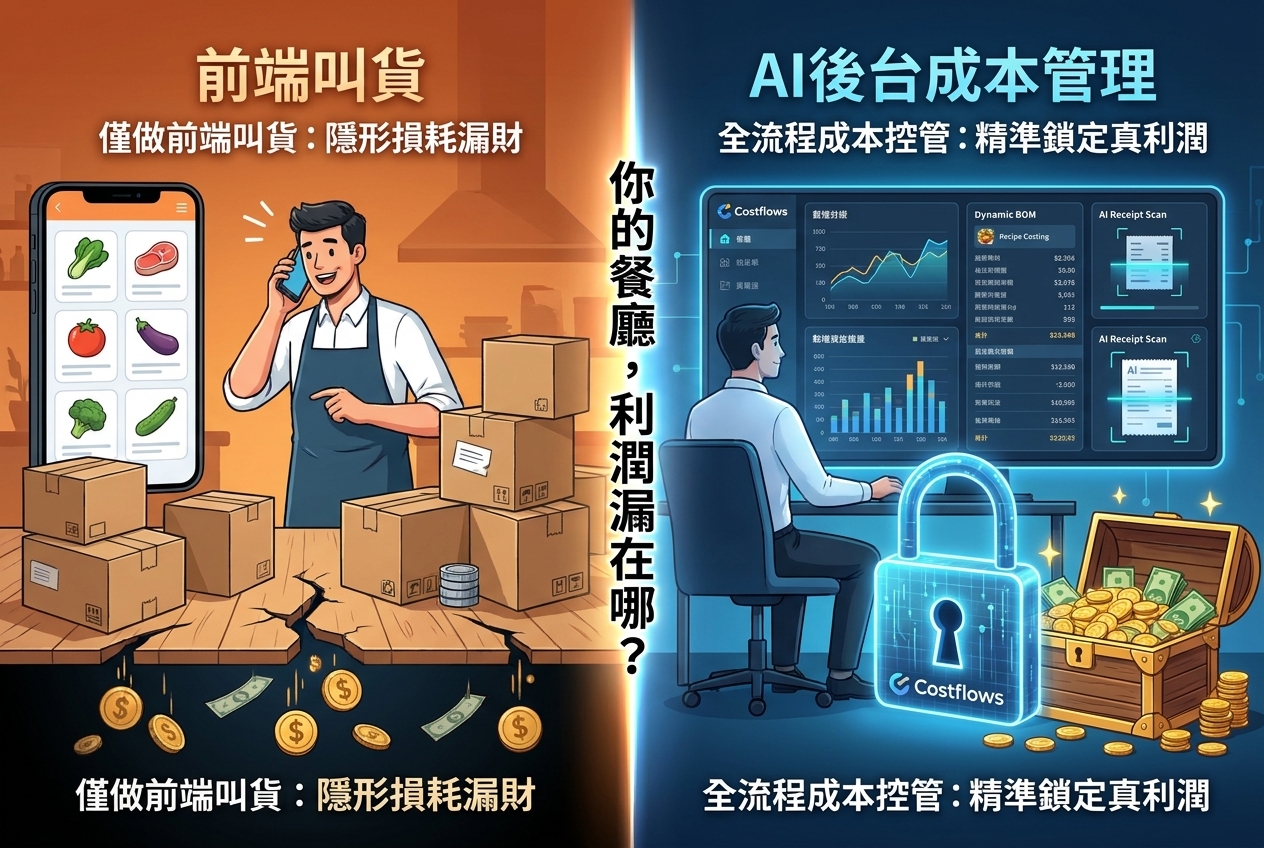
However, if your reality involves traditional vendors who refuse to use apps, handwritten invoices flying around, frequent petty cash runs, daily market price fluctuations, and a strong desire to track plate margins and kitchen waste, you don't just need an ordering tool. You need a back-to-front, AI- and cost-driven restaurant operations system like Costflows:

Op.

Conclusion: True Digital Transformation Means Every Dollar is Visible and Accounted For

The whole point of digital transformation is to give restaurant operators real-time visibility into their margins and costs—without waiting until the middle of next month to close the books.

Instead of forcing old-school vegetable vendors to learn a new app, or expecting busy chefs to manually type in dozens of updated invoice prices during the lunch rush, let Costflows' AI technology do the heavy lifting. By automating invoice matching, inventory deduction, and cost analysis, you can finally put an end to the nightmare of seeing "$30k in the system, but $100k on the final bill."

Frequently Asked Questions (FAQ) — Restaurant Procurement & Cost Control Guide

Q1: Why don’t my restaurant’s actual month-end costs match our purchasing software?
It usually boils down to three things: First, many fresh food vendors still take orders via phone/text (using handwritten invoices), and store petty cash purchases aren't logged in the ordering app. Second, staff only use the system to place orders, forgetting to update market prices and actual received quantities upon delivery. Third, ordering apps only track monthly purchases, completely ignoring inventory consumption changes (beginning vs. ending inventory) and central kitchen transfer costs.
Q2: What’s the difference between "Purchasing Spend" and "Cost of Goods Sold (COGS)" on a P&L statement?
"Purchasing Spend" is simply the total cash you spent buying ingredients from vendors that month. "COGS," on the other hand, is the actual cost of the ingredients you consumed to generate sales that month. The formula is: COGS = Beginning Inventory + Net Purchases – Ending Inventory. If you burn through a lot of stock left over from last month, your COGS will be much higher than your monthly purchasing spend.
Q3: How can we digitize our workflow if traditional vendors only use handwritten invoices and refuse to use online ordering apps?
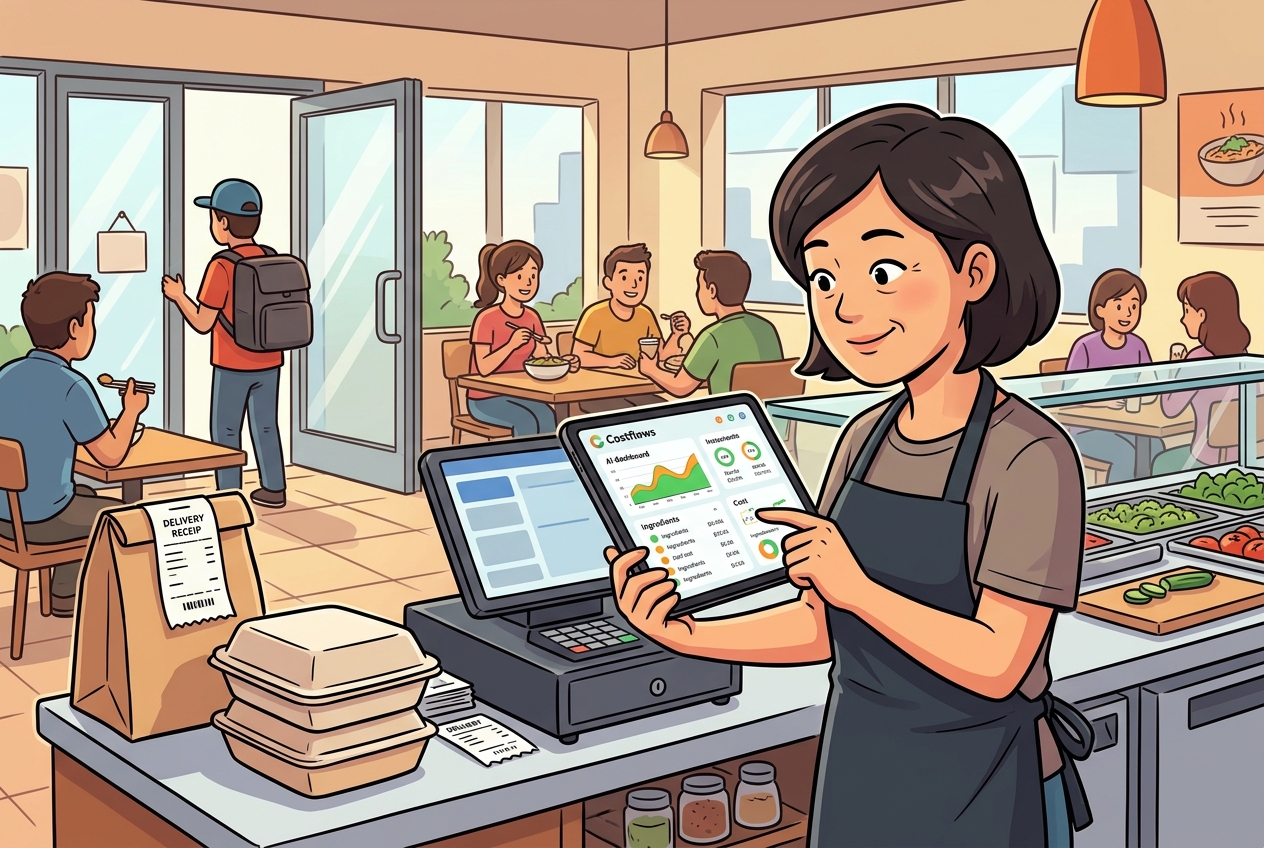
The best approach is to adopt a restaurant cost management system equipped with AI OCR (Optical Character Recognition), like Costflows. You don't have to force traditional suppliers to change their habits. Your kitchen staff simply snaps a photo of the handwritten delivery slip or invoice when goods arrive. Within seconds, the AI extracts the items, units, unit prices, and totals—turning paper slips directly into actionable digital cost data.
Q4: What is the difference between ordering platforms like CocoMart and a cost management system like Costflows?
They solve different problems. Platforms like CocoMart are front-end procurement tools focused on streamlining how you send orders and communicate with suppliers. Costflows is an end-to-end AI restaurant cost and operations system. Its core strength lies in using AI to scan invoices and handwritten slips, tracking ingredient price fluctuations, managing inventory counts and central kitchen transfers, and integrating with your POS and recipes (BOM) to calculate true plate margins and COGS.
Q5: How can restaurants prevent sneaky vendor price hikes or excessive kitchen waste from blowing up month-end costs?
You need two things: real-time invoice digitization and Theoretical vs. Actual Cost variance tracking. With Costflows, every time staff snaps a photo of an incoming invoice, the system cross-checks historical prices and triggers an instant alert if a supplier quietly raises prices. By combining POS sales data with month-end stocktakes, the system automatically spots the gap between what you should have used (theoretical) and what you actually used—helping you pinpoint whether the issue is over-portioning, prep waste, or theft.

‍

Zoe Chen

Zoe Chen

Digital Marketer

F&B Insights





Subscribe To Our Newsletter - Webtech X Webflow Template

訂閱最新消息

不要錯過任何餐飲的資訊


Thanks for joining our newsletter.
Oops! Something went wrong.

其他資訊

瀏覽全部
Can Restaurant Ordering Systems Truly Uncover Food Costs? Comparing CocoMart vs. Costflows for Real Profit
Market Insights

Can Restaurant Ordering Systems Truly Uncover Food Costs? Comparing CocoMart vs. Costflows for Real Profit

Ordering apps save time, but do they save margin? Discover Costflows.

前往

Delivery App Fees Are Climbing: How Restaurants Can Protect Margins with Smart Cost Control
Market Insights

Delivery App Fees Are Climbing: How Restaurants Can Protect Margins with Smart Cost Control

Protect restaurant margins from rising delivery fees with Costflows AI.

前往


Are you considering what you need? Try it now for free

free trialCONTACT US
Program features
  • Restaurant cost control
  • Procurement management
  • Storage and loss management
  • Benefit analysis of menu recipes
  • Chain brand/franchise management
  • Central kitchen/factory process management
Other links
  • Costflows Intelligence
  • List of clients
  • Newbie on the road
  • Update log
Other links
其他連結
  • 自動擷取支出
  • 如何開始
  • 價錢
  • 關於我們
  • 對比其他軟件的優勢
  • 開放式API
Social Networ
  • Facebook (Asia)
  • Instagram (Asia)
  • Youtube
  • Twitter (X)
  • LinkedIn
  • Threads
  • Facebook (Global)
Subscribe To Our Newsletter - Webtech X Webflow Template
Get our latest news

We launch some new features every month, subscribe to our email and keep in touch.


Thanks for joining our newsletter.
Oops! Something went long.

© Copyright 2026. All Rights Reserved by Costflows Limited | Privacy Policy & Term of Use