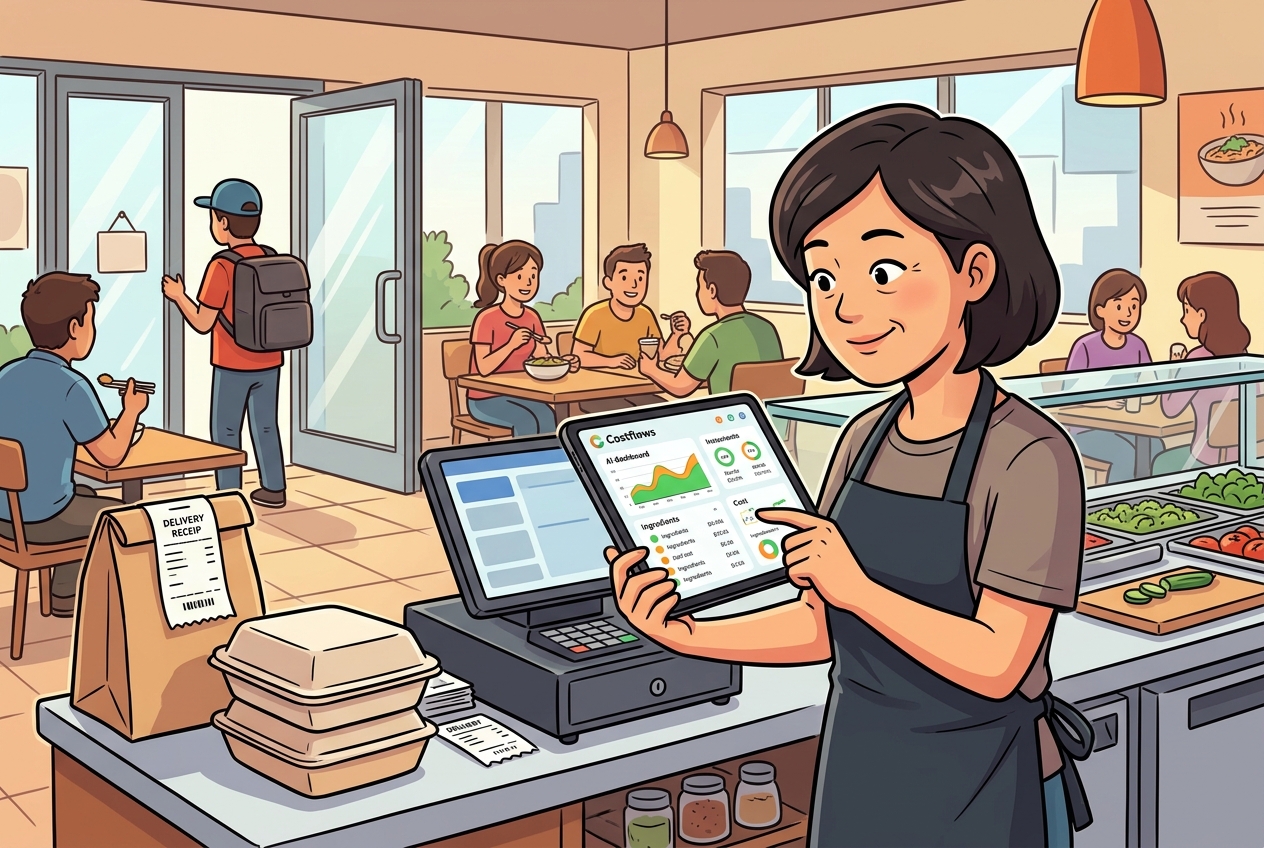
<p>After closing each day, you might think you are "reconciling," but many restaurants are actually "searching for accounts." Invoices are tucked in the chef’s pocket, delivery notes are clipped next to the chopping board, and WhatsApp is flooded with voice-recorded quotes—all for the store manager to eventually patch up in Excel. By month-end, when accounting asks why chicken breast became more expensive, everyone can only answer based on "gut feeling."</p> <p>The true goal of restaurant reconciliation is not just to align numbers, but to turn every expenditure into a traceable chain of evidence: who ordered, who received, what was the quantity and unit price, were there returns, were there missing entries, and did it ultimately reflect in the <a href="https://www.costflows.com/analysis-report/profit-and-loss-report">Profit and Loss Report</a>. Below is a breakdown of the most common restaurant workflows to make reconciliation actionable, quantifiable, and transferable.</p> <h2>Define the Boundaries of Reconciliation</h2> <p>Reconciliation is not a single action but a set of verification relationships. At a minimum, three lines must be managed simultaneously: the supplier document line, the payment line, and the goods flow line.</p> <p>The supplier document line (purchase orders, delivery notes, invoices) determines "how much should be paid." The payment line (bank transfers, checks, credit cards, cash, and prepayments) determines "how much was actually paid." The goods flow line (<a href="https://www.costflows.com/analysis-report/inventory-report">receiving, storage, usage, waste, and stocktake</a>) determines "did the items actually arrive and were they recorded correctly."</p> <p>Matching only documents to payments ignores missing goods or incorrect delivery quantities. Matching only inventory to goods flow ignores hidden price hikes. A proper system ensures these three lines form a closed loop under the same set of rules.</p> <h2>How to Reconcile: Start Daily to Stop the Bleeding</h2> <p>Daily reconciliation aims to handle discrepancies immediately rather than letting them snowball into month-end crises. Fix this process to 15-30 minutes after closing or the next morning, focusing on standardization.</p> <h3>Document Collection Must Be "Same-Day"</h3> <p>All procurement documents must enter a single gateway: photographed and uploaded, centrally stored, or forwarded to a unified channel. Require receiving staff or the duty manager to complete this during the receiving process. Efficiency gaps usually occur not in finance, but because the front line fails to submit documents on time.</p> <h3>Use "Three-Point Matching" to Catch Discrepancies</h3> <p>Daily reconciliation should focus on the points most likely to hurt gross margins: quantity, unit price, and missing entries.</p> <p>Quantity errors stem from weight shortages or unit conversion mistakes. Unit price errors come from temporary supplier hikes or mismatched quotes. Missing entries lead to "zero cost on books but zero stock in the kitchen," a disaster discovered only at month-end. Identifying these daily allows for immediate correction with suppliers or drivers.</p> <h2>Monthly Reconciliation: Creating an Auditable Trail</h2> <p>Monthly reconciliation is about organizing the entire month’s evidence chain to withstand questioning from owners, auditors, or partners.</p> <h3>Suppliers First, Payments Second, Then Categorized Reports</h3> <p>Many restaurants summarize by category (meat, seafood, dry goods) first, only to find the totals don't match. It is more effective to align by supplier, reconcile payments one by one, and only then categorize.</p> <p>Suppliers are the source of discrepancies. By calculating "accounts payable this month" per supplier and matching it against "actual payments," you can quickly pinpoint whether the issue is a missing invoice, a duplicate entry, an uncredited return, or a payment recorded in the wrong month.</p> <h3>Managing "Cross-Month" Transitions</h3> <p>The biggest errors in restaurant accounting aren't calculation mistakes—they are timing issues. For example, receiving goods on the 31st but getting the invoice on the 2nd. Establish clear rules: an operational view recognizes costs on the delivery date, while a financial view follows the invoice or payment. Both are valid as long as the system links the document to the receiving record for traceability.</p> <h2>Identify the Source of Discrepancies</h2> <p>Reconciliation fails when errors aren't structured. Common errors include: missing/late documents, inconsistent units (e.g., buying by the "box" vs. "kg"), unclosed loops on returns/replacements, and human error such as duplicate entries.</p> <p>Turn these into a fixed checklist for daily and monthly workflows, defining who is responsible and how to handle each type of error when found.</p> <h2>Accelerate the Flow Across Departments</h2> <p>Reconciliation stalls when there is an information gap. Procurement knows the order, the kitchen knows the goods, but accounting only sees the payment. To move faster, let each role do what they do best: procurement records expected prices, receiving confirms actual arrivals with photos, managers handle exceptions, and accountants handle payment matching.</p> <p>When this chain is smooth, reconciliation becomes a series of small daily habits rather than a month-end nightmare.</p> <h2>The Limits of Excel</h2> <p>While Excel is a starting point, it has three fatal flaws: fragmented document entry, high manual labor costs, and a lack of auditable links (e.g., matching a payment to specific delivery notes). As you grow to multiple locations or handle dozens of invoices daily, error rates rise, and management becomes reactive rather than proactive.</p> <h2>Using Automation to Turn "Data Entry" into Discipline</h2> <p>The bottleneck of reconciliation is data entry. Automating document capture ensures that every invoice starts with structured data: supplier, date, items, quantity, and price. </p> <p>Tools centered on AI data extraction can automatically turn photos of <a href="https://www.costflows.com/purchase-invoice-automation">invoices into data</a> while keeping the original image as proof. This makes it easier to spot price fluctuations or high waste patterns instantly.</p> <p>For a standardized approach, consider how <a href="https://www.costflows.com">Costflows</a> institutionalizes the process. It uses OCR and intelligent analysis to transform handwriting and printed bills into structured data, allowing management to see price trends and supplier performance immediately, drastically reducing month-end closing time.</p> <h2>Making Reconciliation a Sustainable KPI</h2> <p>Evaluate your success using two metrics: Reconciliation Lead Time (time from receiving to entry) and Discrepancy Rate. A lower discrepancy rate usually indicates stronger procurement and receiving discipline.</p> <p>Reconciliation isn't just a back-office chore; it is a tool for management to negotiate better prices, replace underperforming suppliers, and control gross margin fluctuations. Those 15 minutes after closing determine whether you have the data to protect your profits.</p>
.png)

訂閱最新消息
不要錯過任何餐飲的資訊